



Optocouplers are also known as optoisolators
Optocouplers, also known as optoisolators, optocouplers or optoisolators, are components that use light to transmit electrical signals between two isolated circuits. Digital CMOS isolators are components that use high frequency carriers to transmit electrical signals between two isolated circuits. Both optocouplers and digital isolators are used to prevent high voltages from affecting the signals received by the system.
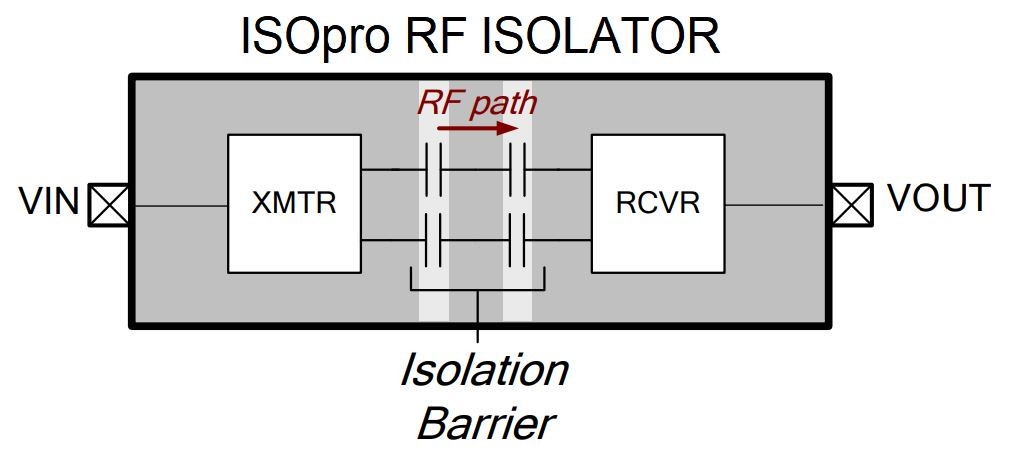
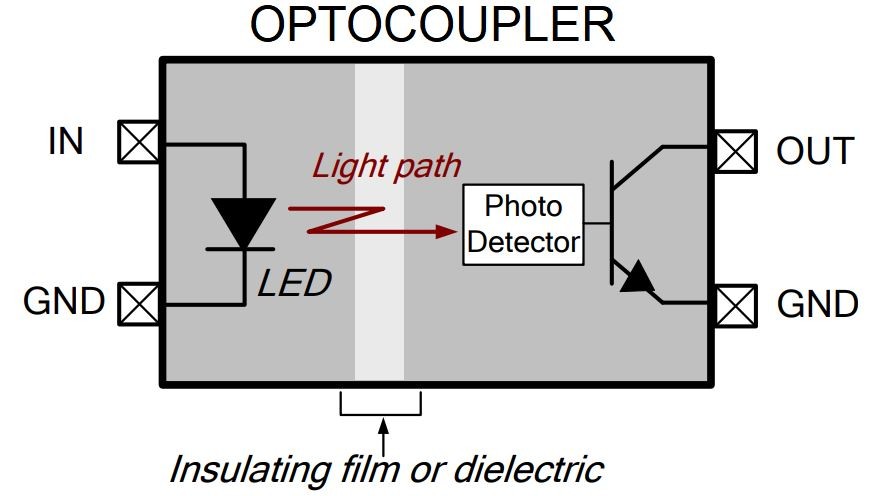
Figure 1 shows the basic form of an optocoupler. The signal input can be considered as a transmitting unit (LED) and the signal output can be considered as a receiving unit (photodetector or other type of photosensitive semiconductor element). The current flowing through the LED causes the emitted light to pass through the dielectric, where it strikes the photodetector, causing the current to flow and biasing the output transistor. Both the transmitting and receiving units are contained in a hermetically sealed package with an insulating film or dielectric between the input and output.
Similarly, Figure 2 shows the basic form of a digital isolator. Two identical semiconductor chips are connected in a standard integrated circuit package to form an RF transmitter and receiver separated by a differential capacitive isolation grid. Data is transferred from the input to the output via a simple on/off key control (OOK). When the vehicle identification number (Vin) is high, the transmitter generates an RF carrier wave that propagates through the isolation barrier to the receiver.
Optocouplers have been the unchallenged signal isolation solution for over 40 years, but digital isolators are becoming increasingly popular due to their superior performance and reliability. Recent breakthroughs in silicon isolation technology have made these improvements possible. CMOS digital isolators enable designers to create isolated circuits that are lower cost, smaller in size, higher performance, lower power consumption, and more reliable than competing optocoupler solutions.
The advantages of an optocoupler isolator over competing optocouplers include:
-Defined critical operating parameters with little to no variation in voltage, temperature and device life
Isolators that are susceptible to temperature, current, and/or device aging force designers to give up design margins and reduce system performance.
-High Reliability and Stability
Optocouplers are now required to have a service life of 20 years or more, as in HEV/EV, solar and wind energy systems, often operating at temperatures in excess of 120°C.
-Minimal electromagnetic interference (EMI) and high external EMF immunity
EMI is a potential source of data corruption, especially in medical applications that acquire low amplitude signals, such as electrocardiogram machines (ECG). External magnetic and electric fields can degrade system performance, so the ability of the isolation device to suppress external magnetic field interference is critical.
-Ease of use
Product applications include:
-Industrial automation
-Power solutions
-Electric/hybrid vehicles
-Inverters (solar and motor control)