



Differences between opto-isolators and optocoupler relays!
The (infrared) beam of the optocoupler effectively isolates the high voltage. But the speed of relay optocouplers is no longer sufficient for today's data technology. So what is the alternative to current isolation in electronics?
In electronic circuits, whether in test and measurement, in fieldbus systems or in other extensive wiring in production plants, current isolation is required to prevent potentials differences from having potentially fatal effects, either in audio and video engineering so that loops do not occur, or for safety reasons to engage in medical engineering.
Transformers work in different versions with frequencies ranging from a few hertz to gigahertz, but they can only operate at AC voltages. They miss the slowly changing signals and DC voltages. This can only be solved by an amplitude modulated AC voltage that must be demodulated after the transformer. But this will cut off the upper frequency of the possible transformations according to Nyquist to half the frequency of the AC voltage used.
The second disadvantage is not in analog signals, but in digital technology, and it is the lack of pulse accuracy of the transformers: in the frequency range they may be able to cover some power of 10. but the typical square wave data signal is usually distorted. The transformer's inductance causes losses, which can lead to pulse skew, overshoot and phase shift - not exactly true for time-critical edges.
Other disadvantages are the space requirements and the high crosstalk between multiple transformers of the same type. They are usually rarely found on digital SMD boards in conventional winding versions, just as core memory has become a thing of the past due to its size. The only advantage of the transformer: Like the classical linear transformer, it has very little power loss when converting from primary to secondary side. This way, if the transmitted signal is strong enough, the secondary part of the circuit can usually be managed without its own energy source.
In more modern IC designs, as planar transformers on silicon chips, such devices have 1-4 channels. They offer speeds of up to 100 Mbit/s, use edge detection, and initially cannot transmit DC voltages and low-frequency AC voltages, so an auxiliary oscillator of about 500 kHz is implemented in the IC to which these signals can be modulated. However, unlike conventional transformers, these chips cannot carry large amounts of energy. Therefore, the device needs power on the secondary side as well. In addition, the magnetic lines are not retained in the component as in a conventional transformer, which means poorer electromagnetic compatibility. Here, too, the auxiliary oscillator creates EMC problems.
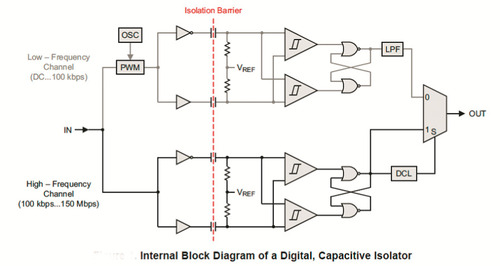
Capacitive coupling
One option is the capacitive coupler. As a potential isolation capacitor, it is simple in form and can be found in almost every AF and RF amplifier. As a fully galvanically isolated solution capable of complete bending, things get more complicated: DC voltages and slowly changing low frequency waveforms can only be transmitted by modulating the signal to AC voltage.
In the actual circuit, the two channels directly cover the range from 100 kbit/s to 150 Mbit/s and then from the DC voltage to 100 kbit/s by pulse width modulation. After the capacitive isolation path, two channels are added again: a powerful but relatively complex solution. Like all other outputs except the optocoupler relay, the outputs produce either 3V or 5V logic levels. Here again, EMC is limited, plus the signal edge rise and fall times and delay times limit the actual data rate.
High frequency conversion as an alternative
Another possibility is to continue with the capacitive or inductive modulation principle and transmit at 2.1 GHz with HF and inductive transformers - in other words, no real HF transmission. Thus, in theory, it is possible to transmit digital signals up to 1 GHz. In practice, rates of up to 150 Mbit/s are provided. despite this, the crosstalk between the individual channels is not negligible. Another problem is the influence of other HF transmitters used near the band, such as UMTS/LTE phones or 2.4GHz ISM transmitters, which are almost universally present in video transmission, Bluetooth, ZigBee, WLAN, microwave ovens and other applications ad infinitum. Therefore, if these devices are used in an assembly with a "true" wireless system, problems may arise despite the possibility of screening. At these high frequencies, the radiation from the components themselves cannot be ignored, despite the presence of transformers. Therefore, this variation is not welcome in all types of telecommunication units.